How Many Solar Panels Do I Need for My House?
Most homes need between 17 and 25 solar panels to cover their electricity usage, depending on monthly energy consumption, panel wattage, and sunlight.
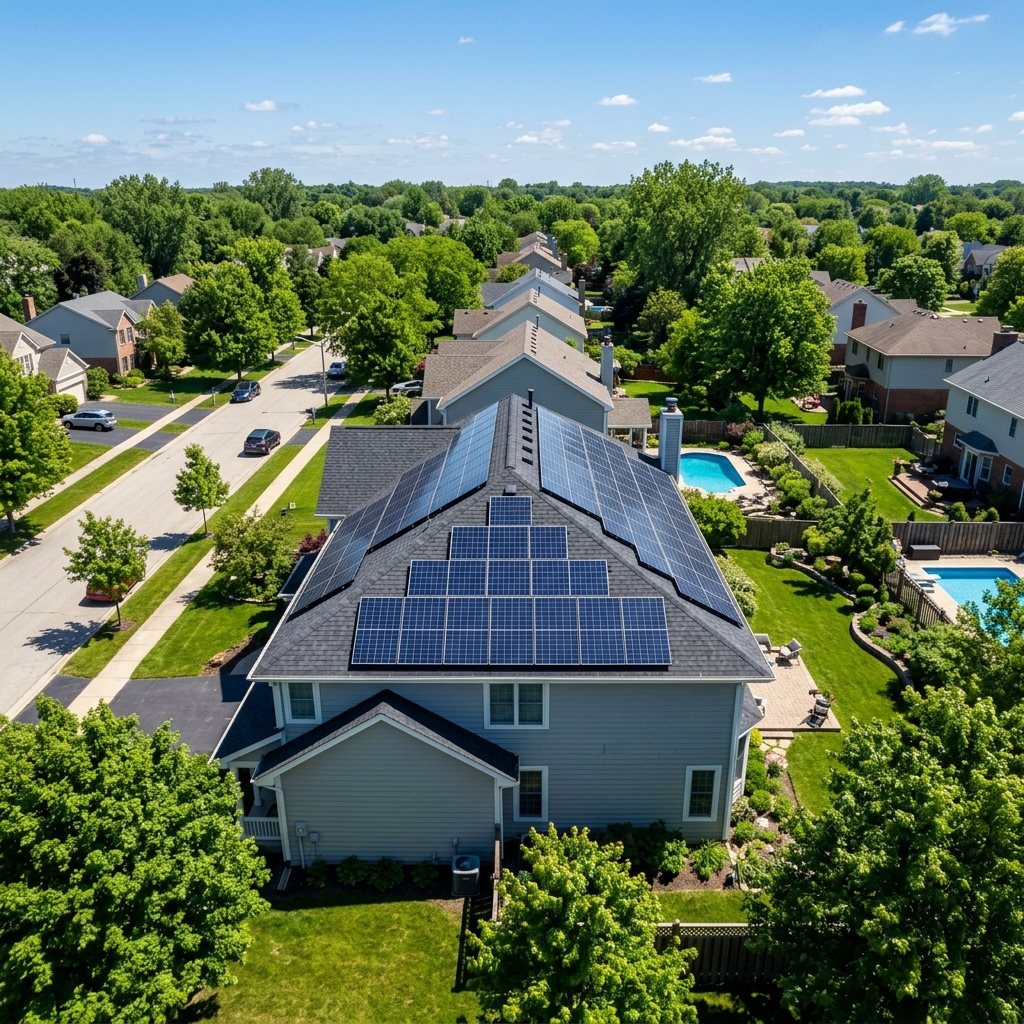
Most homes need between 17 and 25 solar panels to cover their electricity usage, depending on your monthly energy consumption, panel wattage, and how much sunlight your roof gets. The exact number comes down to a simple formula you can calculate in under a minute — and a handful of real-world factors that can shift that number up or down. Below, we'll walk through the formula, a full worked example, what actually changes your count, panel counts by home size and by climate, and the mistakes people commonly make when estimating this themselves.
The Quick Formula
Number of panels = (Monthly kWh usage ÷ Peak sun hours ÷ Panel wattage) × 30
Here's what each piece means:
Monthly kWh usage
Check your electricity bill for this number. This is your actual consumption, listed as "kWh used" on most utility statements. Most US homes use 850–950 kWh/month, but this varies widely by region, home size, and whether you have electric heating, AC, or an EV.
Peak sun hours
This is the average daily hours of full-strength sunlight your specific location receives. It is not the same as daylight hours — it accounts for sun intensity, not just daylight duration. Peak sun hours typically range from 3 hours in parts of the Pacific Northwest to over 6 hours in the Southwest.
Panel wattage
This is the power rating of a single panel, printed on its spec sheet. Most residential panels installed today are rated 350–450 watts, with 400W being the most common mid-range option.
Step-by-Step: How to Calculate It Yourself
- Pull your last 12 months of electricity bills and calculate your average monthly kWh usage (using a full year smooths out seasonal swings from AC or heating).
- Look up your local peak sun hours. You can find this from NREL solar resource maps or simply search "[your city] peak sun hours."
- Decide on panel wattage. If you haven't chosen an installer yet, use 400W as a reasonable planning estimate.
- Plug the numbers into the formula above to get your system size in kW, then convert to panel count.
- Add a buffer of 10–20% if you plan to add an EV charger, heat pump, or pool pump in the next few years — it's cheaper to size correctly now than to add panels later.
Worked Example
Say your home uses 900 kWh/month, you get 5 peak sun hours/day, and you're using 400-watt panels.
- Convert monthly usage to daily usage: 900 kWh ÷ 30 days = 30 kWh/day
- Divide daily usage by peak sun hours to find required system size: 30 kWh ÷ 5 hours = 6 kW system needed
- Divide system size by panel wattage to get panel count: 6,000 watts ÷ 400 watts = 15 panels
- Add a 20% buffer for real-world system losses (wiring, inverter efficiency, dust, and panel degradation). Installers typically size up 15–25% above the theoretical minimum: 15 × 1.2 ≈ 18 panels
This gives you a real-world system size of about 7.2 kW, which lines up with the typical 6–8 kW system most US homes install.
Why Installers Add a Buffer
The raw formula tells you the theoretical minimum, but no solar installer sizes a system at the exact bare minimum. Panels lose 0.5–1% efficiency per year, inverters have their own conversion losses (typically 2–5%), and panels rarely perform at 100% of rated output due to heat, dust, and imperfect angles. This is why the "quick formula" number and the "real quote from an installer" number are usually 15–25% apart — and why the worked example above is closer to reality than the bare theoretical calculation.
What Changes the Number
Your actual panel count can shift based on several factors, some more significant than others:
- Household size and usage habits — a 4-bedroom home with central AC and an EV charger can use 2–3x the electricity of a 2-bedroom home with modest usage, directly scaling panel count.
- Roof orientation and shading — south-facing, unshaded roofs in the Northern Hemisphere generate significantly more power per panel than north-facing or partially shaded roofs, sometimes reducing output by 10–30%.
- Panel efficiency — higher-wattage, higher-efficiency panels (420W+ premium panels versus 350W standard panels) mean fewer panels for the same total output, though usually at a higher per-panel cost.
- Local sun hours — homes in Arizona or Nevada need meaningfully fewer panels than homes in Washington or Michigan for the same usage, simply due to climate.
- Roof pitch and tilt angle — panels installed at their optimal tilt angle (generally close to your latitude) produce more power than flat-mounted panels.
- Battery storage goals — if you want to bank extra power for outages or nighttime use, you'll size up beyond your baseline daytime usage.
- Net metering policy in your area — in states with strong net metering, some homeowners intentionally oversize slightly to bank credits; in states without it, oversizing wastes money.
Quick Reference: Panels by Home Size
| Home Size | Avg. Monthly Usage | Typical Panel Count (400W panels) |
|---|---|---|
| Small (1–2 bed) | 500–600 kWh | 12–15 panels |
| Medium (3 bed) | 800–900 kWh | 17–20 panels |
| Large (4+ bed) | 1,100–1,300 kWh | 24–28 panels |
| Large + EV charger | 1,400–1,700 kWh | 30–36 panels |
Panel Count by Climate/Region
Because peak sun hours vary so much by geography, the same 900 kWh/month home needs a different number of panels depending on where it's located:
| Region (example) | Approx. Peak Sun Hours | Panels Needed (900 kWh/month home) |
|---|---|---|
| Southwest (e.g., Arizona, Nevada) | 6+ hours/day | 15–17 panels |
| Southeast (e.g., Florida, Georgia) | 5–5.5 hours/day | 17–19 panels |
| Midwest (e.g., Ohio, Illinois) | 4–4.5 hours/day | 19–22 panels |
| Pacific Northwest (e.g., Washington, Oregon) | 3–3.5 hours/day | 22–26 panels |
This is why two homes with identical electricity bills can end up with noticeably different solar quotes — the sunlight available at each location, not just the usage, drives a large part of the panel count.
Common Mistakes When Estimating Panel Count
- Using daylight hours instead of peak sun hours — a location can have 10 hours of daylight but only 4.5 peak sun hours, which leads to underestimating the system needed.
- Ignoring shading — trees, chimneys, or neighboring buildings that shade even part of an array can meaningfully cut output, and this isn't captured by the basic formula.
- Not accounting for future usage — adding an EV or heat pump 2 years after installing solar often means either a second, less efficient installation or living with a shortfall.
- Assuming all panels are the same wattage — mixing up a quote based on 350W panels with one based on 400W panels will make the panel counts look inconsistent when they're actually describing similar system sizes.
Get Your Exact Number
The formula and tables above give you a solid estimate, but your roof size, shading, local sunlight data, and panel wattage will all shift the real answer. Use Solarity's free Solar Savings Calculator to get your exact panel count, system size, and cost estimate based on your actual address and electricity bill.
Not sure your roof can physically fit the system you need? Check your roof's capacity with our Roof Size Estimator to see how many panels will actually fit and at what tilt angle for maximum output.
Frequently asked questions
How many solar panels does an average 3-bedroom house need?
Most 3-bedroom homes need 17–20 panels, based on average monthly usage of 800–900 kWh, standard 400-watt panels, and around 5 peak sun hours per day. Homes in sunnier climates may need fewer; homes in cloudier regions may need more.
Can I have too many solar panels?
Yes — oversizing your system well beyond your usage wastes money unless you're planning for future usage growth (like an EV or heat pump) or you live in an area with favorable net metering that lets you bank credits for excess production.
Does panel wattage affect how many I need?
Yes. Higher-wattage panels (400W and above) produce more power per panel, so you'll need fewer of them to hit the same total output compared to older 250–300W panels. This is why panel count alone isn't a perfect comparison between quotes — total system wattage matters more.
Do I need more panels if I want a battery backup?
Generally yes. Battery systems need extra generation capacity to charge the battery in addition to covering your daily usage, so homeowners adding storage typically size up by 10–20% compared to a grid-tied-only system.
Will my panel count change based on my roof's tilt angle?
Yes. Panels installed at the optimal tilt for your latitude produce more energy per panel than flat-mounted or steeply angled panels, which can change your required count by 5–15%.
How accurate is the quick formula compared to a professional quote?
The formula gives a solid ballpark, typically within 15–25% of what a professional site assessment will recommend, since it doesn't account for shading, roof condition, or real-world system losses. Use it for early planning, then confirm with a calculator or installer quote before finalizing.